



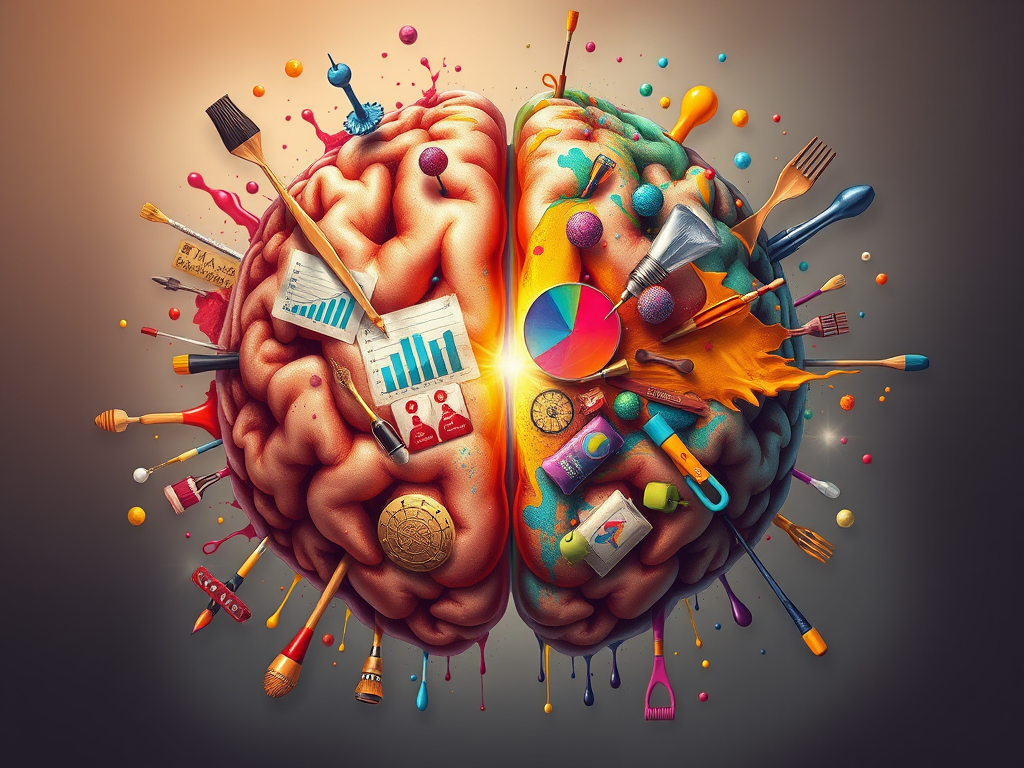
Have you ever felt like you’re good at a lot of things but not a “true expert” at any one thing? If so, welcome to my world. We live in a society that’s obsessed with specialization, yet some of us just don’t fit that mold—and I’m starting to think that’s not a weakness but a superpower.
The Split Brain Stereotype
We’ve all heard it:
- You’re either left-brained (logical, analytical, data-driven)
- Or you’re right-brained (creative, intuitive, artistic)
But what about those of us who live in the middle? People like me who get equally excited about building a complex spreadsheet AND experimenting with acrylics on a Saturday afternoon?
I find joy in analyzing data but can lose myself just as easily in texture, design, and creative expression. My brain is constantly bouncing between these seemingly contradictory worlds. I’m driven by curiosity, not just completion. And while I don’t have fancy letters after my name in any single discipline, I bring something to the table that’s often overlooked—the ability to connect dots between worlds that don’t usually talk to each other.
When My “Split Brain” Sparked Something Bigger
I experienced this recently while exploring AI technologies. In the middle of learning about how these systems work, my mind suddenly jumped tracks. “I see tons of marketing that is skeptical,” I found myself saying. “How could we create an AI watchdog on our phone or computer to help us detect scams?”
Within minutes, I was mapping out a nonprofit, AI-powered tool that could help people identify misleading marketing, potential scams, and manipulative content they encounter online. The idea flowed naturally as my brain shifted between creative possibility (“what if we could…”) and logical structure (“how would this actually work…”).
My excitement quickly ran into the practical brick wall of reality—this kind of tool would require significant funding for developers to perform consistent upgrades to stay ahead of ever-evolving scam tactics. It wasn’t something I could bootstrap on my own. The vision of a personal watchdog that wasn’t controlled by a large corporation was compelling, but the practical execution would be complex.
And yet, I don’t consider this a failure of thinking. This is exactly how my hybrid brain works—visionary leaps followed by practical assessment, creative possibilities tempered by logical constraints. The idea itself still has merit, even if the path to execution isn’t immediately clear.
Why This Matters More Than Ever
In a world that keeps pushing us to specialize more and more narrowly, we often undervalue the generalists, the connectors, and the curious explorers. Yet, these are exactly the people who:
- See patterns others miss
- Ask the questions that break down silos
- Build bridges between logic and imagination
I’ve found this especially true in my own journey. With the rise of AI, big data, and automation, the ability to interpret insights creatively and apply them meaningfully is becoming just as critical as technical expertise.
From Data to Design: My Personal Playground
I find myself constantly asking:
- “What could this data mean in real life?”
- “How could this insight inspire a new way of thinking?”
- “How can I take something dry and make it relatable, visual, or even beautiful?”
Whether I’m analyzing trends, experimenting with AI tools, or simply creating something with my hands, I’m learning that I don’t need to fit into the “expert” mold to make an impact. Some of my most meaningful contributions have come precisely because I wasn’t limited by specialized thinking.
What If You’re Wired This Way Too?
If you’ve ever felt “not specialized enough” or been made to feel like a jack-of-all-trades is somehow lesser, I invite you to reframe it:
- You are a dot connector
- You are a creative analyst
- You are a curious explorer
- You see things others overlook
And in today’s rapidly shifting world, that might be one of the most powerful skillsets of all. I’m still figuring out how to leverage this wiring of mine, but I’m done apologizing for not being “expert enough” in any one thing.
Are you a fellow bridge-builder between the worlds of data and creativity? I’d love to hear how you’ve made this intersection work for you!
 Awareness-Hub
Leave a comment