


The Allure of the Oracle
Artificial intelligence is sold to us as an oracle — a near-magical assistant that can answer any question, solve problems, and even help us think. But here’s the question nobody asks: who owns the oracle you’re peering into? Because ownership isn’t just business. In countries where governments have their hands on the levers, it means direct control.
I learned this in the automotive industry. Any company operating in China is tethered to the state — through ownership stakes, Party committees, or laws that compel cooperation. You don’t get to say no. It’s not paranoia; it’s structure. And now, the same system is wrapped around AI.
China’s AI Model: Innovation with Handcuffs
China’s National Intelligence Law (2017) requires every citizen and company to “support, assist and cooperate with state intelligence work.” Large firms are required to host Party committees inside their walls. The government often holds “golden shares,” which give it veto power.
What does that mean for AI?
- Models like DeepSeek or Baidu’s Ernie Bot aren’t just clever chatbots. They’re built on datasets that may include surveillance state material: faces, voices, biometrics.
- Apps like TikTok and CapCut act as global funnels of behavioral data. Fun on the front end, intelligence goldmine on the back end.
- The answers these tools give are subtly aligned to Party narratives.
And here’s the kicker: even Western tech giants sometimes blur the lines. Google Cloud has made DeepSeek models available through its Vertex AI platform. That means a state-tethered Chinese model can slip quietly into Western business pipelines. It’s not a hypothetical risk — the entanglement is already happening.
When Western companies make mistakes, regulators fine them, lawsuits follow, and the press calls them out. In China, criticism gets censored, and the model keeps shaping truth to fit the Party line.
Russia’s AI Model: Control by Default
Russia plays a different but familiar game. The Kremlin doesn’t need golden shares — it has SORM surveillance laws, and companies operate knowing compliance isn’t optional.
The ecosystem:
- GigaChat (Sberbank) — Russia’s homegrown ChatGPT rival, run by a state-owned lender.
- Alice (Yandex) — 60 million monthly users, powered by YandexGPT. A friendly voice assistant built on a Russian model.
- MAX — a new state-backed messaging app, mandated to be pre-installed on all devices in Russia. Critics call it spyware.
- RuStore — the state app store, where approved apps live and foreign competitors are blocked.
If you think of these as neutral tech tools, you’re missing the point. They’re control infrastructure dressed as convenience.
Not Just China and Russia
Don’t assume the pattern stops there. Other countries are following the same playbook in different flavors:
- India is rapidly rolling out AI-driven surveillance in cities — facial recognition, predictive policing, traffic monitoring — often without clear oversight or rights protections (Oxford Human Rights Hub). Innovation is happening, but privacy is the casualty.
- United Arab Emirates (UAE) has turned AI into a state project. Companies like G42 are chaired by senior security officials, and the government launched MGX, a state-owned AI investment fund. The UAE even banned unauthorized AI-generated images of national figures. In other words: the state owns the ecosystem.
- Others are watching closely. Iran, North Korea, and smaller authoritarian states are experimenting with AI-driven censorship, predictive policing, and propaganda models. It may not be polished, but the intent is the same — AI as a control tool.
Spotting the Pattern
China, Russia, India, the UAE — not identical systems, but overlapping DNA:
- No true corporate independence
- Legal or structural obligation to cooperate with state power
- Censorship and propaganda shaping outputs
- Data treated as a national resource, not private property
The difference with Western firms isn’t sainthood. It’s that they face checks and balances — transparency reports, independent press, court challenges, regulatory penalties. Flawed, yes. But still accountable.
Why Users Should Care
Here’s the part that matters for you and me: if you use an AI assistant or app built under one of these exploitative systems, assume your data is accessible to the government behind it. That includes your prompts, your metadata (IP address, device, location), and the subtle influence of the model’s answers.
You may not be personally targeted. But your information could fuel a machine that strengthens authoritarian control, or shapes narratives in ways you don’t even notice.
Safe vs. Unsafe Apps
Safer (with caveats):
- ChatGPT (OpenAI/Microsoft)
- Claude (Anthropic)
- Google Gemini
- Microsoft Copilot
High Risk:
- China: DeepSeek, Baidu Ernie Bot, Tencent AI, iFlytek, TikTok, CapCut, Shein, Temu
- Russia: GigaChat, Alice/YandexGPT, MAX messenger, RuStore
- UAE: G42, MGX (state-backed investment ecosystem)
- India: State-run facial recognition/predictive policing platforms (not consumer-facing, but a warning sign of government-first priorities)
Rule of thumb: if the government can’t be challenged in court, assume your data belongs to them too.
The Verdict
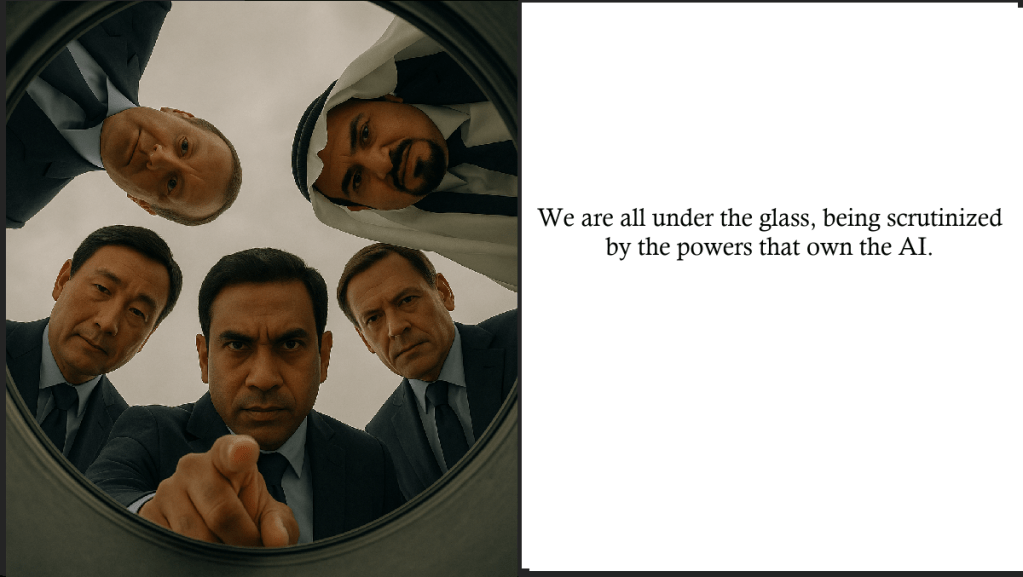
The oracle is only as trustworthy as the hands behind the glass. In China and Russia, the hands are the state’s. In India and the UAE, state alignment is tightening fast. In the West, the hands are flawed corporations — but at least you have a fighting chance for transparency and redress.
Don’t be fooled by branding. Ask: who ultimately owns this brain? Because the answer to that question may shape the answer the oracle gives you next.
Leave your thoughts below — do you trust an AI oracle that someone else controls?
Sources
- National Intelligence Law of the PRC (2017) — Library of Congress
- Google–DeepSeek collaboration — The Register
- Russian surveillance law (SORM) — Wikipedia
- India’s AI surveillance and privacy concerns — Oxford Human Rights Hub
- India AI regulation landscape — Carnegie Endowment
- UAE’s AI holding company G42 — Wikipedia
- UAE’s MGX AI investment fund — Wikipedia
- UAE ban on unauthorized AI-generated images — Times of India
 Awareness-Hub
Leave a comment